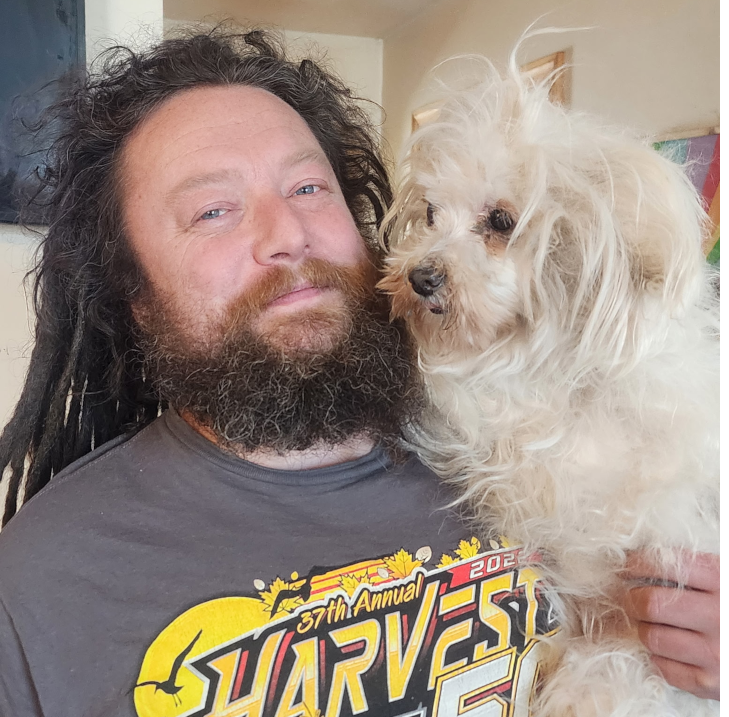
Bio
Work-in-Progress
My interest in technology began early. Around kindergarten, my father introduced me to GW-BASIC on an 8088 PC, and from then on there always seemed to be a computer somewhere in our living room. Around the same time, he gave me a Hallicrafters shortwave radio from the tube era—the kind that needed time to warm up before it came to life.
Computers and radio quickly became parallel interests. I spent countless hours experimenting with software while also listening to distant voices and signals on the shortwave radio, fascinated by the idea that information could travel invisibly across the world. Number stations—mysterious broadcasts of voices, tones, and seemingly random sequences of numbers—captured my imagination. Together with the alien worlds and unsettling villains of Doctor Who, they fostered a lasting interest in communications, encryption, privacy, and understanding how complex systems work.
I still remember working with MS-DOS 3.3 and the excitement of upgrading to MS-DOS 5.0. Before I learned about Unix tools like awk and sed, I was using EDLIN with batch files to automate changes to text files. By scripting EDLIN commands, I could locate specific lines and replace them with dynamically generated values as part of DOS batch workflows. I spent countless hours experimenting with CONFIG.SYS and AUTOEXEC.BAT, tuning HIMEM.SYS, EMM386, and other memory managers, trying every trick I could find to squeeze a little more conventional memory out of a system.
Installing a Sound Blaster card, configuring an ARCnet network adapter, resolving IRQ and DMA conflicts, or adding an Adaptec SCSI controller usually meant spending time experimenting and troubleshooting. Computers weren’t appliances yet—they invited exploration. Like many people of that era, I also spent more time than I probably should have talking to Dr. Sbaitso, amazed that a home computer could suddenly produce recognizable speech.
To afford a 486 system of my own, I worked as a dishwasher in a local restaurant kitchen and saved what I could. It felt like a major milestone. Wolfenstein 3D ran well enough on a 386, but a 486 made it noticeably smoother.
Networking was another area that quickly captured my interest. I experimented with ARCnet before later moving to Ethernet and spent time learning Novell NetWare 3.x and 4.x, Windows NT, OS/2, Linux, and BSD systems. By the mid-1990s, my friends and I were networking computers together for Doom deathmatches over IPX/SPX, learning practical networking concepts long before we knew the formal terminology. Many of my earliest lessons in networking came from simply trying to make systems communicate with one another.
As my computers became more connected, I spent time on local bulletin board systems and eventually discovered larger communities through networks such as FidoNet. Conversations were no longer limited to people in my area code. Ideas, discussions, and friendships could travel across the country—and sometimes around the world—through a patchwork of interconnected systems.
As Internet access became more common, I immersed myself in Usenet newsgroups, IRC, websites, email, mailing lists, Linux User Groups, and open-source communities.
During that period, I read books, participated in online discussions, and regularly read publications such as Wired. I encountered the work of Richard Stallman, John Perry Barlow, Bruce Sterling, William Gibson, Jaron Lanier, and many others who were writing about software freedom, privacy, digital rights, virtual communities, and the social impact of emerging technologies. Organizations such as the Electronic Frontier Foundation and ACLU also broadened my understanding of the relationship between technology, civil liberties, and public discourse.
Around the same time, I discovered books such as The Cuckoo’s Egg by Clifford Stoll and The Masters of Deception by Michelle Slatalla and Joshua Quittner. I later had the opportunity to hear Stoll speak at Dayton Hamvention. I became interested in cryptography and privacy, particularly the work of Phil Zimmermann and Pretty Good Privacy (PGP), even choosing Zimmermann as the subject of a school report. I also participated in distributed.net’s RC5 distributed computing project, contributing spare CPU cycles to a worldwide collaborative effort.
In the mid-1990s, I began supporting small business networks and desktop systems at a local computer shop, gaining hands-on experience with hardware, operating systems, networking, and customer support.
My professional foundation in IT deepened during my time at UC Santa Cruz, where I progressed from Tier I help desk support for a campus of 18,000 students, staff, and faculty to Tier II support and eventually dedicated workstation and server support for approximately 300 clients across departments including IT, Human Resources, Risk & Safety Services, Financial Affairs, the Registrar’s Office, Title IX, Police, Physical Plant, Receiving, Business Services, and the Chancellor’s Office.
Working as part of a small team, I supported enterprise environments running a wide range of applications, including Enterprise Resource Planning (ERP) systems such as PeopleSoft and Banner, and business intelligence (BI) applications such as Business Objects/Crystal Reports, ensuring client installations, database connectivity, and operational readiness for end users and development staff. I also administered and maintained critical infrastructure supporting academic and administrative operations across the university, including a campus-wide emergency alerting system, WebCBT—the university’s online learning platform—and multiple departmental database, file, print, and domain servers.
From 2004 to 2013, I served as IT Coordinator for a worker-owned restaurant cooperative supporting approximately 90 people across multiple business units, including a restaurant, bakery, bar, nightclub, manufacturing facility, catering operation, and festival and farmers market presence. I was responsible for designing, implementing, and maintaining the organization’s technology infrastructure.
Much of what I built during my time as IT Coordinator, I first had to learn. I came in knowing what a resilient system needed to look like—but not always how to implement each piece. I learned one technology at a time, introducing changes incrementally while keeping critical systems online. User training was a central part of the process. Whether migrating users from Windows to Linux, introducing LibreOffice, or eventually moving services to Google Workspace, I made user adoption as much a priority as the technical implementation itself.
Nearly everything I learned about technology during the first three decades of my career was self-directed. Whether I was configuring DOS memory managers, building networks, administering Linux systems, participating in online communities, or implementing infrastructure in professional environments, the process was usually the same: identify a problem, research it, experiment, and keep learning until it worked.
I entered a formal classroom environment to study cybersecurity and networking in my mid-forties. By then, I had already spent most of my life learning technology by doing. I view my cybersecurity education as a continuation of that process rather than its beginning.