
Project Athena
Published:
Project Athena
Project Athena began in 1983 as a partnership between MIT, Digital Equipment Corporation (DEC), and IBM. It developed a distributed computing environment that allowed your personal files and settings to follow you from one Athena workstation to another. Technologies used in the environment included Kerberos, Hesiod, Ingres, Moira, Zephyr, the Andrew File System (AFS), and the X Window System.
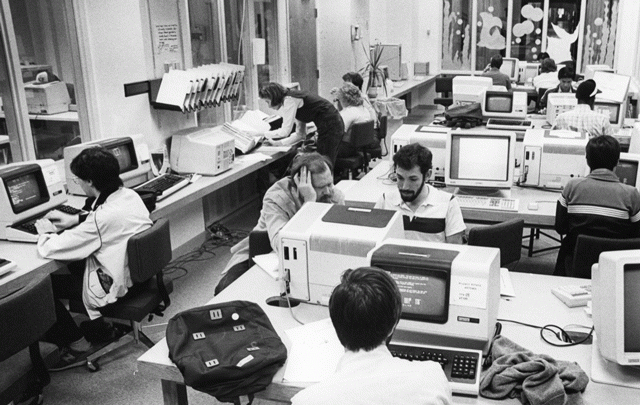
Project Athena workstations at MIT. Photo courtesy of the MIT Museum, via MIT News.
My Experience at UC Santa Cruz
I was lucky enough to be hired in 1999 into Communications and Technology Services (CATS), part of the Distributed Computing Group at UC Santa Cruz, where I was given an account in this environment. I started out at the help desk there. As an end user, I experienced the tail end of one of the many historic developments in computing.
UCSC adopted Project Athena around 1989. We would log in to a system named meow.ucsc.edu, running SunOS. If I recall correctly, you could run ls /afs and see directories for other AFS sites around the world.
UCSC was starting to phase out the system around the time I was hired. By 2002, email had moved to a newer system, and by the mid-2000s, the university had moved away from the broader Athena environment. I believe they are still running the distributed file system, though, so that’s cool.
How Athena Fit Together
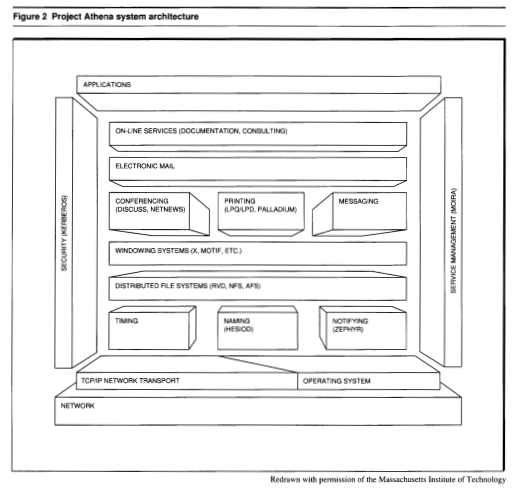
Project Athena system architecture. Figure 2 from J. M. Arfman and P. Roden, “Project Athena: Supporting distributed computing at MIT,” IBM Systems Journal, volume 31, number 3, 1992, page 555. The figure was redrawn with MIT’s permission, according to its original credit. Scan via Bitsavers.
Athena’s Continued Evolution
The original Project Athena partnership ended in 1991, but the computing environment continued to evolve. I’ve come across two later projects: Debathena brought Athena to Debian and Ubuntu, but hasn’t been updated since Ubuntu 18.04. Its intended successor, Nixathena, brings Athena to modern NixOS and carries Project Athena’s legacy forward today, in 2026.
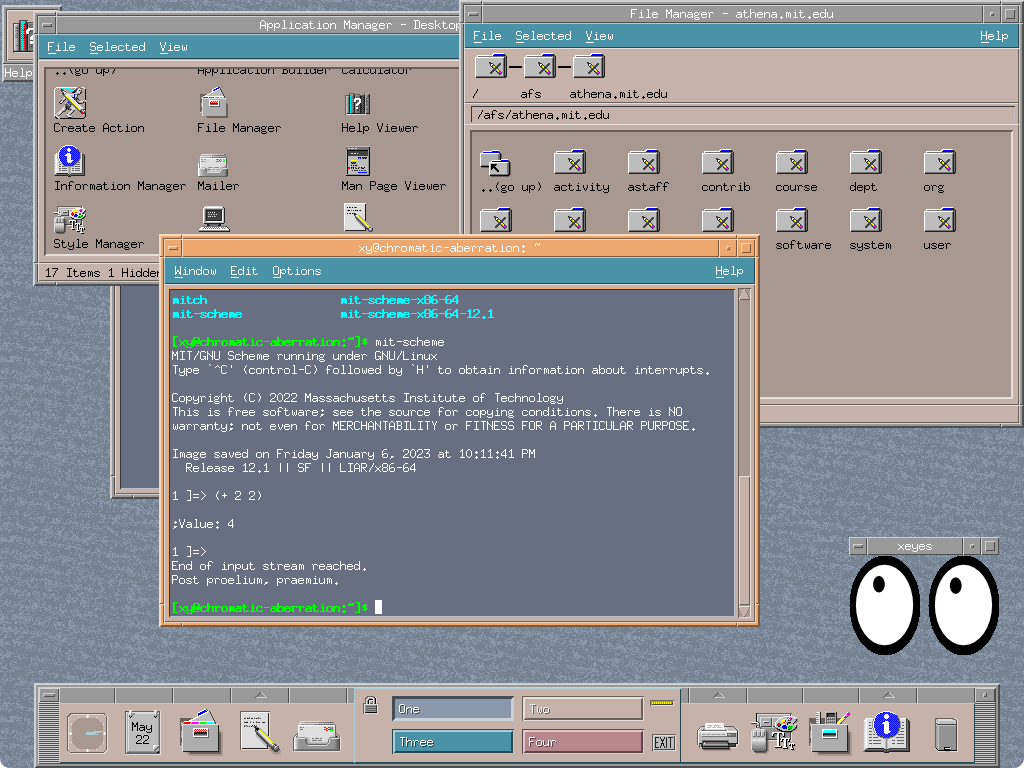
The Common Desktop Environment (CDE) running on Nixathena. Screenshot from the Nixathena project, MIT Student Information Processing Board (SIPB).
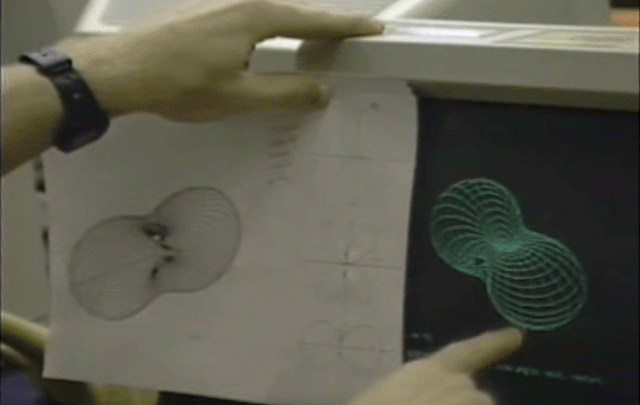
MIT electrical engineering and computer science students using Athena workstations to visualize electric fields, 1984. Photo courtesy of the MIT Infinite History Project, via MIT News.
Further Reading
Here are some articles and a book I found for further reading:
MIT Project Athena: A Model for Distributed Campus Computing — George A. Champine, 1991, Digital Press. A book-length account of Athena’s design, implementation, and operation, drawing on project reports and the author’s firsthand experience. Read the scanned book (PDF), originally downloaded from Bitsavers.
Project Athena: Supporting distributed computing at MIT — 1992, IBM Systems Journal, volume 31, number 3. A technical overview by J. M. Arfman and P. Roden explaining Athena’s architecture, network services, and administration, including how users could access their files and applications from different workstations.
Project Athena: Success in Engineering Projects — Fall 1999. A student research paper examining Athena’s educational goals, technical achievements, and the competing priorities of MIT faculty, IBM, and DEC.
MIT Athena: Not Dead Yet — 2008. An earlier perspective on Athena’s continued life, referenced by the 2026 Nixathena announcement.
Looking back at Project Athena — November 11, 2018. An MIT News retrospective on how Athena brought computing into students’ everyday education, its partnership with IBM and DEC, and its lasting influence.
MIT Athena: Somehow Still Not Dead Yet — Anthony Wang, May 23, 2026. An introduction to Nixathena, a SIPB project intended to replace Debathena and bring Athena workstations to modern NixOS, with links to features, screenshots, and source code.